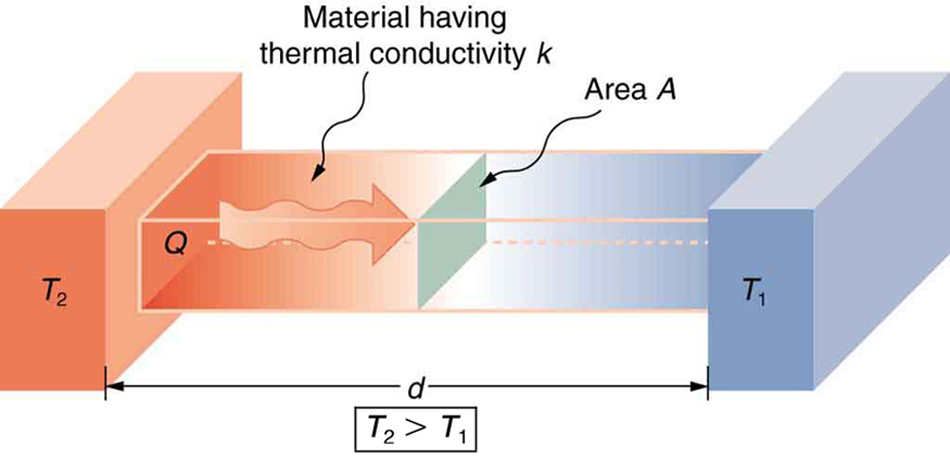
The heat flux and the temperature distribution in a medium depend on the conditions at the surfaces, and the description of a heat transfer problem in a medium is not complete without a full description of the thermal conditions at the bounding surfaces of the medium.
Example: The temperature distribution in a medium depends on the conditions at the boundaries of the medium as well as the heat transfer mechanism inside the medium.
es: Condiciones de borde
Emissivity
noun
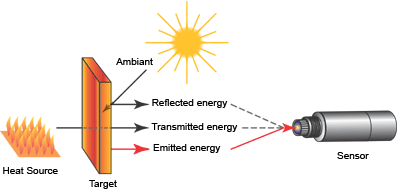
Emissivity is defined as the ratio of the energy radiated from a material's surface to that radiated from a perfect emitter, known as a blackbody, at the same temperature and wavelength and under the same viewing conditions. It is a dimensionless number between 0 (for a perfect reflector) and 1 (for a perfect emitter).
Example: Polished stainless steel, has an emissivity of approximately 0.1 and therefore emits only one tenth the amount of energy of a blackbody at the same temperature.
es: Emisividad
Energy balance
noun
The net change (increase or decrease) in the total energy of the system during a process is equal to the difference between the total energy entering and the total energy leaving the system during that process.
Example: All energies into the system are equal to all energies leaving the system plus the change in storage of energies within the system.
es: Balance de energía
Heat conduction equation
noun
The heat conduction equation is a partial differential equation that describes the distribution of heat (or the temperature fields) in a given body over time. Detailed knowledge of the temperature field is very important in thermal conduction through materials.
Example: The ice, when put in a cup of boiling water, melts completely.
es: Ecuación de conducción de calor
Heat flux
noun
Heat flux or thermal flux, is a flow of energy per unit of area per unit of time. In SI its units are watts per square metre (W/m2). It has both a direction and a magnitude, and so it is a vector quantity. To define the heat flux at a certain point in space, one takes the limiting case where the size of the surface becomes infinitesimally small.
Example: Standing close to a fire feels hot: the temperature of a fire is much higher than the surrounding air.
es: Flujo de calor
Insulation
noun
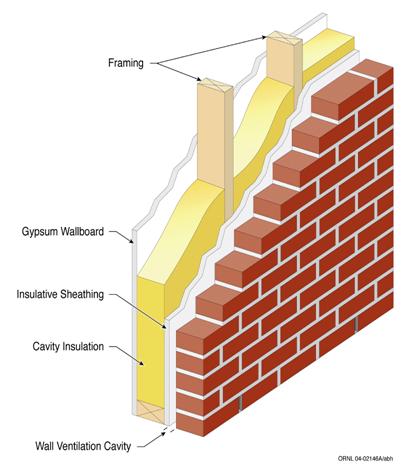
Insulation means creating a barrier between the hot and the cold object that reduces heat transfer by either reflecting thermal radiation or decreasing thermal conduction and convection from one object to the other. Depending on the material of the barrier, the insulation will be more or less effective.
Example: If the air outside is cold, you may want to protect your skin by wearing clothes that keep the cold out and the body warmth in
es: Aislamiento
Internal energy
noun
The internal energy of a thermodynamic system is the energy contained within it. It is the energy necessary to create or prepare the system in any given internal state. It does not include the kinetic energy of motion of the system as a whole, nor the potential energy of the system as a whole due to external force fields, including the energy of displacement of the surroundings of the system. It keeps account of the gains and losses of energy of the system that are due to changes in its internal state.
Example: A room temperature glass of water sitting on a table has no apparent energy, either potential or kinetic. But on the microscopic scale it is a seething mass of high speed molecules traveling at hundreds of meters per second. If the water were tossed across the room, this microscopic energy would not necessarily be changed when we superimpose an ordered large scale motion on the water as a whole.
es: Energía interna
Isotropic system
noun
Isotropic systems are uniform regardless of direction
Example: Radiation may be isotropic when the the observed intensity is the same in all directions from the source.
es: Sistema isotrópico
Specific heat
noun
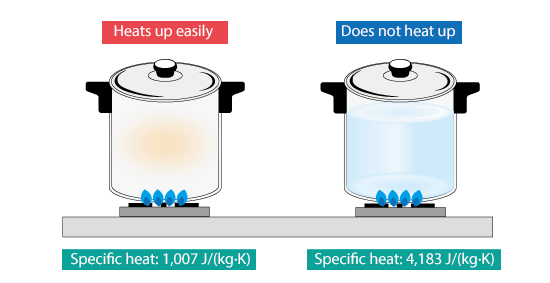
The quantity of heat required to raise the temperature of one gram of a substance by one Celsius degree. The units of specific heat are usually calories or joules per gram per Celsius degree.
Example: The heat required to raise the temperature of 1 kg of water by 1 K is 4184 joules, so the specific heat capacity of water is 4184 J⋅kg⋅K.
es: Calor específico
Temperature
noun
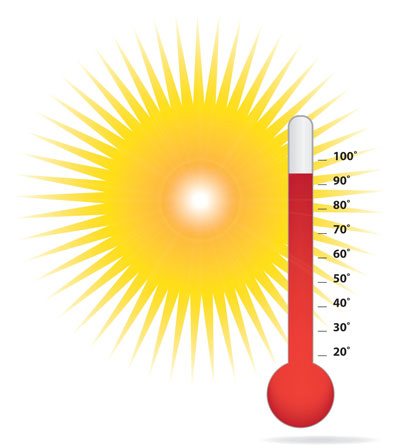
Is a physical quantity that expresses hot and cold. It is the manifestation of thermal energy, present in all matter, which is the source of the occurrence of heat, a flow of energy, when a body is in contact with another that is colder or hotter.
Example: The lowest temperatures ever recorded was -129 Fahrenheit in Vostok, Antarctica.
es: Temperatura
Temperature gradient
noun
A temperature gradient is a physical quantity that describes in which direction and at what rate the temperature changes the most rapidly around a particular location. The temperature gradient is a dimensional quantity expressed in units of degrees (on a particular temperature scale) per unit length.
Example: The temperature at the western edge of the map is 75 degrees Fahrenheit and the temperature at the eastern edge is 50 degrees Fahrenheit.
es: Gradiente de temperatura
Thermal conductivity
noun
The thermal conductivity (k) is a measure of a material’s ability to conduct heat.
Example: Walking on bathroom tile in winter is annoying since it feels so much colder than the carpet. This is interesting, since the carpet and tile are usually both at the same temperature. Tile and stone conduct heat more rapidly than carpet and fabrics, so tile and stone feel colder in winter since they transfer heat out of your foot faster than the carpet does.
es: Conductividad térmica
Thermal diffusivity
noun
In heat transfer analysis, thermal diffusivity is the thermal conductivity divided by density and specific heat capacity at constant pressure. It measures the rate of transfer of heat of a material from the hot end to the cold end.
Example: Air has a low thermal conductivity but a relatively high thermal diffusivity this means that while air can only absorb a relatively small amount of thermal energy, it is effective at diffusing the energy.
es: Difusividad térmica
Thermal energy
noun
Thermal energy refers to the energy contained within a system that is responsible for its temperature. Heat is the flow of thermal energy. Is produced when a rise in temperature causes atoms and molecules to move faster and collide with each other.
Example: The warmth from the sun.
es: Energía térmica
Thermal symmetry
noun
Heat transfer through a properly insulated surface can be taken to be zero since adequate insulation reduces heat transfer through a surface to negligible levels.
Example: The two surfaces of a large hot plate of thickness L suspended vertically in air will be subjected to the same thermal conditions, and thus the temperature distribution will be symmetrical (i.e. in one half of the plate will be the same temperature profile as that in the other half).